Sunday, 21 February 2016

Extreme Weather: 6 dead from Tropical Cyclone Winston

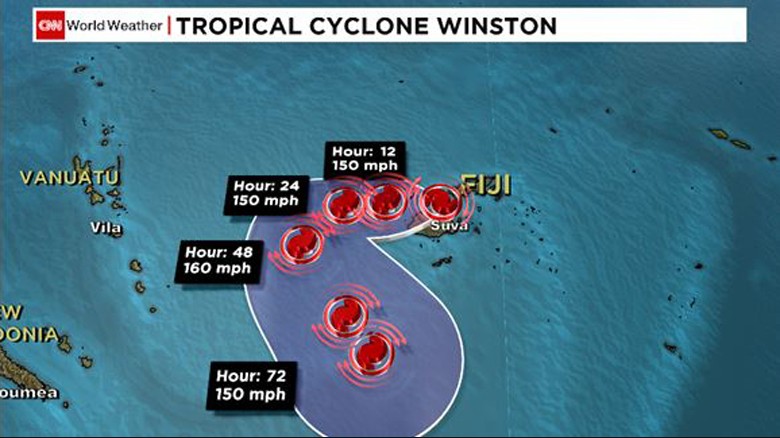
This map showed a forecast track for the storm from early Sunday through early Wednesday Fiji time.

Six people were killed in Fiji when Tropical Cyclone Winston struck the island nation, according to the United Nations' Office for the Coordination of Humanitarian Affairs. The storm was the most powerful on record in the Southern Hemisphere.

Authorities believe the brunt of Tropical Cyclone Winston, which struck Saturday night, has passed. Now comes the arduous task of assessing and cleaning up the damage inflicted by the most powerful storm on record in the Southern Hemisphere.
    Fiji will close all its schools for one week after the storm struck the island nation, the country's Ministry of Rural and Maritime Development and National Disaster Management said.
    Winds that reached 296 kilometers per hour (184 mph) lashed the tiny island nation in the Pacific, felling trees, knocking out power and causing heavy flooding, the Joint Typhoon Warning Center reported.
    "Winston was a monster of a cyclone," Fiji resident Nazeem Kasim told CNN. "I have not experienced anything like this before in my life, nor has my 60-year-old father."
    Fiji Prime Minister Frank Bainimarama declared a state of emergency that will be in effect for 30 days, according to the Fiji Times.
    A nationwide curfew remains in effect as emergency crews clear roads of downed trees and restore power. The curfew is expected to be lifted at 5:30 a.m. Monday local time. All civil servants were expected to return to work after the curfew is lifted.
    Nadi International Airport will open for passenger processing Monday morning.
    The storm wreaked havoc on the tourist hot spot and could still end up hitting the South Pacific nation even more over the coming days.
    CNN meteorologist Michael Guy said Winston is expected to "keep strength as it continues on its path in open waters," but said "it will weaken Tuesday or Wednesday once it hits cooler waters and stronger shear."
    Winston's 184-mph winds smashed the previous record for a Southern Hemisphere cyclone. According to Colorado State University hurricane expert Philip Klotzbach, both Cyclone Zoe, which battered the Solomon Islands in 2002, and Cyclone Monica, which walloped Australia in 2006, previously shared the record with their estimated winds of 178 mph.
    Had it occurred in the Atlantic, Winston would have been a Category 5 hurricane, but because of hemispheric nomenclature, it's dubbed a cyclone.
    So far, the government has reported only one fatality -- in Nabasovi, on Koro Island.
    "It is likely that smaller villages across Fiji will have suffered the most, given their infrastructures would be too weak to withstand the power of a category 5 cyclone," said Suva resident Alice Clements, a spokeswoman for UNICEF in the Pacific.
    "Families may have lost their homes and crops, therefore leaving them without shelter, food and a livelihood."
    Although not hit directly, the capital Suva endured damaging gale-force winds, heavy rain and power outages. Clements, who was in Suva when the storm struck, said the city experienced "destructive, howling winds, and the sound of rivets lifting from roofs a constant throughout the night."
    More than 1,200 people were in evacuation centers around the country, the disaster management ministry said.
    The Colonial War Memorial Hospital in Suva suffered extensive water damage, and the roof of a local hospital was blown off in the northwestern town of Ba, said Sune Gudnitz, head of the U.N. Office for the Coordination of Humanitarian Affairs Regional Office for the Pacific.
    Widespread flash flooding and coastal inundation -- flooding in normally dry land -- "is likely as storm surges may push the sea inland several hundred meters," the Red Cross said.
    The western city of Nadi, on Fiji's main island, suffered minor wind damage but experienced extensive flooding, TVNZ reported.
    "This is a mountainous nation, and that means any heavy rainfall will filter down to the lower elevations -- meaning landslides, mudslides and flooding," told CNN.
    Fiji, an archipelago collectively about the size of New Jersey, lies in the South Pacific Ocean some 1,800 miles from Australia's east coast.
    Most of the nation's 900,000 residents live on one of two main islands: Viti Levu or Vanua Levu.

    'I bleach my eyebrows every day': Lady Gaga

    'I bleach my eyebrows every day': Lady Gaga, pictured in New York on Wednesday, revealed her beauty routine to Vogue 
    'I bleach my eyebrows every day': Lady Gaga, pictured in New York on Wednesday, revealed her beauty routine to Vogue 

    Lady Gaga bleaches her eyebrows 'every day'.

    The Til It Happens To You hitmaker has revealed the strict beauty routine she sticks to, which keeps her brows looking fabulous.

    She told Vogue magazine: 'I bleach my eyebrows every day - I like to keep them light. They're more versatile for a beauty look. You can draw [your eyebrows] any way you want when they're bleached.'

    And whilst Lady Gaga has a wealth of beauty tips, she previously insisted she would never release her own clothing collection because she has too much 'respect' for fashion designers.

    She said: 'The thing is, at the end of the day, I have a real respect for fashion designers. And it's the reason I don't have my own line and the reason I never will.

    'If I ever do anything in fashion, it will always just be as a muse or as an aesthetic, creative. I like to be a part of helping artists find themselves and feel good about who they are. 

    'I would never for a second claim to be proficient in fashion design [just] because I know good looks.

    '[One of the things] I've really learned from Brandon is that he's able to see in me this extremely kind of girlish, feminine side of myself that I don't naturally see because I'm more of an imaginative person, and I don't really identify one way or another with my fashion.' 

    The Applause Singer has been having an incredible 2016 on top of her Golden Globe win for FX's AHS: Hotel, and engagement to fiancé Taylor Kinney.

    Lady Gaga also modeled on the Marc Jacobs catwalk this week, following her David Bowie tribute at the Grammys, and belting the Star-Spangled Banner at Superbowl 50. 

    The heavily-tattooed millennial - along with Diane Warren - will next compete at the Academy Awards for Best Original Song (rape documentary The Hunting Ground).

    'I had had my own situation with sexual assault, and I felt compelled to be a part of [the film]. I called [Lady Gaga] and she was kind and brave enough to be a part of it as well with me,' the eight-time Oscar nominee told The Hollywood Reporter.

    INEC Declares David Mark Winner

    The
    The Independent National Electoral Commission (INEC) has declared David Mark winner of the Benue South Senatorial re-run election held on Saturday.

    Senator Mark polled a total of 84,192 votes, to beat Daniel Onjeh of the All Progressives Congress (APC) with 71,621 votes, Channel News reported.
    The returning Officer of the electoral body, Mr Ishaq Eneji, while declaring the result, said that Senator Mark met all the requirements during the conduct of the poll, having majority of the total vote cast.
    However, the APC agent contested the validity of the result declared.
    Responding to the victory and call for supplementary election in the cancelled polling units, Senator Mark said that his election reflected the will of the people.
    The declaration of the re-run election in favour of Senator Mark brings to a close the intense political fireworks prior to the election with both parties trading accusations on plot to manipulate the polls one way or the other, in the report.
    The re-run election followed a Court of Appeal’s judgment which nullified the election of Senator Mark as the Senator representing the zone in an earlier election held on March 28, 2015.

    Senator Mark was the Senate President during the last administration of former President Goodluck Jonathan who was defeated in a comeback bid in the 2015 presidential election by President Muhammadu Buhari of the All Progressives Congress.

    Trump Wins South Carolina, As Clinton Takes Nevada

    "
    Donald Trump has won the South Carolina primary in the republican race for the US President.


    In the democratic contest, Hillary Clinton also defeated Vermont Senator, Bernie Sanders, in a tight race in Nevada, Channel News reported.
    Both results would be key ahead of the “Super Tuesday” round on March 1, when a dozen more states would make their choice.
    Trump’s victory claimed a major scalp when former Florida Governor, Jeb Bush, dropped out of the race.
    He finished a distant fourth, days after former President, George Bush, made a rare political appearance to boost his brother’s campaign, in the report.
    Republican Senators, Ted Cruz and Marco Rubio, were locked in a battle for second place in the state.

    For Republicans, Trump is the one boasting a winning streak. He had a second-place finish in Iowa and double-digit victories in New Hampshire and now in South Carolina.

    The 10 Worst Stereotypes About Successful And Powerful Women

    New-collage65-compressor
    “I’ve been in this field for more than 30 years,” said co-anchor of Today Ann Curry. “I’ve heard a lot of stereotypes.”
    Women continue climbing the rungs of power—building their ranks as heads of state, corporate leaders and media influencers—but their minority status means they still face harsh, limiting assessments based on their gender. “Women are being judged more, even by other women,” said Valerie Young, Ed.D., author of The Secret Thoughts of Successful Women. While male leaders are allowed to have complex personalities, powerful women are often summed up by hackneyed stereotypes that undermine them and their power.
    Forbes Woman tracked down many of the world’s most powerful women, from IMF chief Christine Lagarde to Jill Abramson of the New York Times, to ask: What is your least favorite stereotype about powerful women? Gender and career experts also weighed in on the dangerous notions about female success and how they seep into the collective subconscious. The following represent the 10 most hated and pervasive stereotypes.

    Ice Queen

    Halley Bock, CEO of leadership and development training company Fierce, notes that the ruthless “ice queen” stereotype is rampant. Cultural depictions, like frigid magazine editor Miranda Priestly in The Devil Wears Prada (and her real-world counterpart Anna Wintour of Vogue) and back-stabbing boss Patty Hewes on Damages, paint successful women as unsympathetic power-mongers. It is, of course, a Catch-22. “A woman who shows emotion in the workplace is often cast as too fragile or unstable to lead,” Bock said. “A woman who shows no emotion and keeps it hyper-professional is icy and unfeminine. For many women, it can be a no-win situation.”

    Single and Lonely

    Harvard lecturer Olivia Fox Cabane notes that the strong perception that powerful women are intimidating to men and will need to sacrifice their personal lives may stop women from going after power. Even those women who aren’t interested in marrying, face harsh judgments. Men get to be “bachelors” while women are reduced to “spinsters” and “old-maids.” In fact, when Janet Napolitano was nominated Secretary of Homeland Security, critics said her being single would allow her to “spend more time on the job.”

    Tough

    The first female Executive Editor of The New York TimesJill Abramson is anything but stereotypical. She had a hard-charging career as an investigative reporter at The Wall Street Journal and edited her way to the top of the Times masthead. She’s also a true-blood New Yorker and is writing a book about puppies. Despite her complexities, she must contend with being called “tough” and “brusque,” making the “she’s-tough stereotype” her least favorite. Said Abramson: “As an investigative reporter, I had tough standards and a formidable way of framing and reporting stories, but I don’t think of myself as a tough person.”

    Weak

    Costa Rica President Laura Chinchilla, the country’s first female leader, told me that successful women face typecasting largely because society is still adjusting to women’s recent decision-making power. Chinchilla believes the most pervasive stereotype is that women are “weak,” a perception that may stem from women’s greater desire to build a consensus. “We understand success not as the result of just one person but as the result of a team,” she said. “[It’s a] different way of dealing with power [that] is misunderstood as a kind of weakness.”

    Masculine

    The notion that powerful women must be, lead and look like a man really aggravatesChristine Lagarde, the managing director of the International Monetary Fund. In a video interview with FORBES she said–pumping her fist–she hates the idea that “you have to look like a businessman.” She admitted she sometimes feels the pressure to look the “right” way, but tries to resist not being “overly businesslike.”

    Conniving

    When NBC’s Curry first started her career, she was told she couldn’t be a news reporter because women had “no news judgment.” Now, she’s at the top of her game and says the stereotype that most offends her is “the idea that a woman can only be successful because she somehow connived or engineered her rise–that she could not rise simply because she was too good to be denied.” She has experienced it herself, saying that she gets asked if she “forced” NBC to give her the anchor job or if there was a “backroom deal.” Curry told me, “I find it really annoying.”

    Emotional

    Ellen Lubin-Sherman, executive coach and author of business guide The Essentials of Fabulous, believes one the most dangerous stereotypes female leaders will face is that they are prone to emotional outbursts. Despite Secretary of State Hillary Clinton’s consistent cool-headed demeanor, when she teared up on the campaign trail, the media pounced. Similarly, former Yahoo Chief Carol Bartz is frequently cited for her “salty language,” which has been used as evidence that she is “emotional” and a “loose cannon.”

    Angry

    “Anger is a sign of status in men, but when women show anger they are viewed as less competent,” said Young. First Lady Michelle Obama was condemned as an “angry black woman” when she was campaigning for her husband in the 2008 presidential election. The Harvard-trained lawyer conscientiously softened her image and speeches in order to be more “likable,” becoming better known for her fashion and her unending support of her husband than for her stance on political issues.

    A Token

    Women hold just 16% of corporate board seats. But instead of focusing on balancing things out, they are often devalued as being a “token” of diversity rather than having earned the post. Former U.S. Secretary of State Condoleezza Rice was often the only woman in the room, but her gender didn’t get her there. “While companies take their diversity goals seriously, they are not going to settle for less than the best person for the job,” said  Lynne Sarikas, director of the MBA career center at Northeastern University. “Women are hired because of their education and experience and what they can do for the company.”

    A Cheerleader

    Billie Blair, president and CEO of Change Strategists, notes that prominent women who are considered feminine and warm may be dismissed as “cheerleaders” rather than the strong leaders that they are. When former Alaska Governor Sarah Palin was running for VP, Blair was amazed to hear a male client describe her as “a cheerleader, not a coach nor a quarterback.”

    With Forbes